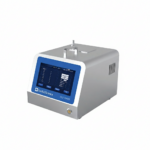

The Laser Dust Particle Counter CLJ-2803 is a precision environmental monitoring instrument utilizing laser light scattering technology for real-time airborne particle measurement across eight size channels (0.3 to 10 micrometers). With a sampling flow rate of 28.3 L/min (1 CFM) and ISO 5-8 cleanroom classification capability, this system provides quantitative assessment of particulate contamination levels essential for maintaining controlled environments in pharmaceutical manufacturing, analytical laboratories, and cleanroom facilities.
Featuring simultaneous multi-channel particle counting with stainless steel construction and >30,000-hour laser lifetime, the CLJ-2803 integrates with laboratory data systems via USB, RS485, and Ethernet interfaces. The instrument supports continuous environmental monitoring protocols required for regulatory compliance in pharmaceutical QC, industrial hygiene assessments, and critical environment validation according to ISO 14644 standards.
The CLJ-2803 employs laser light scattering technology to detect and size airborne particles in real-time. Air samples are drawn through the instrument at 28.3 L/min, passing through a laser beam where particles scatter light proportional to their size. The scattered light is collected by photodetectors and analyzed to determine particle concentration across eight discrete size channels from 0.3 to 10 micrometers.
The system utilizes Mie scattering theory for particle sizing, where the intensity and angular distribution of scattered light correlates with particle diameter. Each detected particle generates a pulse whose amplitude corresponds to particle size, enabling simultaneous counting and sizing across multiple channels. Data processing algorithms convert raw pulse counts to particle concentrations per unit volume, providing ISO 14644-compliant cleanroom classification results.
Continuous sampling and real-time data processing allow for immediate detection of contamination events and trend monitoring over extended periods. The instrument's laser source operates at a wavelength optimized for particle detection sensitivity while maintaining >30,000-hour operational lifetime for reliable long-term monitoring applications.
The CLJ-2803 operates with a sampling flow rate of 28.3 L/min across eight particle size channels (0.3, 0.5, 0.7, 1, 2, 3, 5, and 10 micrometers), providing ISO 5-8 cleanroom classification capability. The instrument features stainless steel construction with compact dimensions of 220×350×260mm and operates on AC220V/50-60Hz power (AC110V optional) with 150W consumption.
Communication capabilities include USB, RS485, and Ethernet interfaces for data system integration. The laser light source provides >30,000 hours operational lifetime, ensuring long-term reliability for continuous monitoring applications. These specifications enable compliance with ISO 14644 standards for cleanroom particle counting and environmental monitoring protocols.
ConductScience provides a standard 1-year manufacturer warranty covering defects in materials and workmanship, with technical support for installation and operational guidance.
| Feature | This Product | Typical Alternative |
|---|---|---|
| Particle Size Range | 0.3-10 μm across 8 channels | 0.3-25 μm across 6 channels |
| Sampling Flow Rate | 28.3 L/min (1 CFM) continuous | 2.83 L/min (0.1 CFM) typical |
| Laser Lifetime | >30,000 hours operational life | 10,000-20,000 hours typical |
| Communication Options | USB, RS485, and Ethernet interfaces | USB only or RS232 serial |
| Construction Material | Stainless steel housing | Plastic or aluminum construction |
The CLJ-2803 positions itself as a high-flow, continuous monitoring solution optimized for cleanroom applications, offering superior sampling statistics and integration capabilities compared to portable alternatives. The focus on regulatory compliance and long-term reliability makes it particularly suitable for pharmaceutical and controlled environment applications where consistent performance is critical.
Calibration: Perform zero count verification monthly using HEPA-filtered air to ensure background contamination does not affect baseline measurements.
Background particle counts can drift over time and affect measurement accuracy, particularly for low-concentration environments.
Maintenance: Inspect and clean sampling tubing quarterly to prevent particle buildup that could cause false readings or flow restrictions.
Contaminated sampling lines are a common source of measurement artifacts and can compromise data integrity.
Best Practices: Position sampling inlets at least 6 inches from walls and obstacles, following ISO 14644-1 guidelines for representative air sampling.
Proper inlet positioning ensures measurements reflect true air quality conditions rather than localized effects from surfaces or airflow patterns.
Best Practices: Allow 30-minute warm-up period after power-on before taking critical measurements to ensure laser stabilization.
Laser output stability directly affects particle detection sensitivity and measurement repeatability.
Troubleshooting: If particle counts appear unusually high, check for leaks in sampling connections and verify inlet is not positioned near contamination sources.
Sampling system integrity is critical for accurate measurements, and nearby contamination sources can skew results.
Data Quality: Document environmental conditions (temperature, humidity) during measurements as these can affect particle behavior and instrument performance.
Environmental parameters influence both particle characteristics and optical measurement principles, affecting data interpretation.
Safety: Ensure proper grounding of the instrument and use appropriate electrical protection in cleanroom environments with flammable solvents.
Electrical safety is critical in controlled environments where static discharge or sparks could pose fire or contamination risks.
Maintenance: Schedule annual calibration verification using NIST-traceable particle standards to maintain regulatory compliance and measurement accuracy.
Regular calibration verification is required for regulatory compliance and ensures long-term measurement reliability in quality-controlled applications.
[1] Liu BYH et al. (1974). Experimental studies of optical particle counters. Atmospheric Environment. DOI: 10.1016/0004-6981(74)90004-3
Foundational paper on laser light scattering principles used in optical particle counting technology.
[2] Whyte W et al. (1982). A study of air movement and microbial contamination in operating theatres. Journal of Hospital Infection. DOI: 10.1016/0195-6701(82)90106-2
Demonstrates application of particle counting for environmental monitoring in controlled medical environments.
[3] Ljungqvist B et al. (1979). Evaluation of four different air-sampling methods to determine the efficiency of laminar airflow units. Applied and Environmental Microbiology.
Validates particle counting methodology for cleanroom performance assessment and contamination control evaluation.
What is the minimum detectable particle size and counting efficiency?
The instrument detects particles down to 0.3 micrometers with counting efficiency typically >50% at the lower size limit, following ISO 21501-4 specifications for optical particle counters.
How does the 28.3 L/min flow rate compare to regulatory requirements?
The 1 CFM (28.3 L/min) flow rate meets ISO 14644-1 requirements for cleanroom classification sampling volumes and provides statistically significant particle counts for ISO 5-8 environments.
What calibration maintenance is required for regulatory compliance?
Annual calibration verification using certified particle standards is recommended, with zero count checks using HEPA-filtered air performed monthly or per facility protocols.
Can the instrument integrate with building management systems?
Yes, multiple communication interfaces (USB, RS485, Ethernet) support integration with BMS, SCADA systems, and laboratory data management platforms for automated data logging.
How does laser lifetime affect long-term operational costs?
The >30,000-hour laser lifetime provides approximately 3.4 years of continuous operation, minimizing maintenance costs and ensuring consistent performance for long-term monitoring programs.
What environmental conditions affect measurement accuracy?
Temperature stability, relative humidity control, and vibration isolation are important; consult specifications for operating ranges and install in controlled environments for optimal accuracy.
How does this compare to condensation particle counters?
Unlike CPCs that detect ultrafine particles through condensation growth, this laser scattering system directly sizes particles 0.3-10 μm without sample conditioning, ideal for cleanroom monitoring applications.
What data output formats are available for regulatory documentation?
The instrument typically provides CSV, PDF reports, and database-compatible formats with timestamping for FDA 21 CFR Part 11 compliance and audit trail requirements.