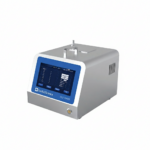

The Laser Dust Particle Counter CLJ-2803 is a precision air quality monitoring instrument designed for real-time particle concentration measurements in controlled environments. Utilizing laser light scattering technology, this system provides simultaneous particle size analysis across eight channels from 0.3 to 10 micrometers, enabling comprehensive assessment of airborne particulate contamination in cleanrooms, laboratories, and controlled manufacturing environments.
With a sampling flow rate of 28.3 L/min (1 CFM), the CLJ-2803 delivers rapid data acquisition suitable for ISO 5-8 cleanroom classification and continuous environmental monitoring. The instrument features multiple communication interfaces (USB, RS485, Ethernet) for seamless integration with facility monitoring systems and data logging protocols. The robust stainless steel construction and >30,000-hour laser lifetime ensure reliable operation in demanding research and industrial applications.
The CLJ-2803 employs laser light scattering photometry to detect and size airborne particles. A diode laser illuminates particles as they pass through a precisely defined sensing volume within the optical chamber. When particles interact with the laser beam, they scatter light at intensities proportional to their size, following Mie scattering theory for spherical particles.
Scattered light is collected by a photodetector and converted to electrical pulses, with pulse height corresponding to particle size. The instrument's eight-channel pulse height analyzer simultaneously categorizes particles into discrete size ranges (0.3, 0.5, 0.7, 1, 2, 3, 5, and 10 μm), providing real-time particle size distribution data. A precision flow control system maintains the 28.3 L/min sampling rate, ensuring accurate volumetric measurements and enabling direct calculation of particle concentrations per cubic meter.
Digital signal processing algorithms eliminate noise and coincidence errors while the long-life laser diode (>30,000 hours) ensures measurement stability over extended monitoring periods. Data output through multiple communication protocols enables integration with building management systems and automated data logging.
The CLJ-2803 provides precision particle monitoring with 0.3-10 μm size discrimination across eight channels and a 28.3 L/min sampling flow rate. The system operates on 220V AC power (110V optional) with 150W power consumption, suitable for continuous operation in laboratory environments. Communication flexibility is provided through USB, RS485, and Ethernet interfaces for seamless data integration.
The compact stainless steel housing (220x350x260mm, 14kg) accommodates desktop installation while the >30,000-hour laser lifetime ensures long-term measurement stability. The instrument's measurement range covers ISO 5-8 cleanroom classifications, enabling compliance monitoring across a wide range of controlled environment applications.
Q: What is the minimum detectable particle concentration for each size channel?
A: Minimum detectable concentration depends on sampling time and statistical requirements. For 1-minute sampling at 28.3 L/min, the instrument can reliably detect concentrations as low as 1-2 particles per cubic foot for larger particles (>1 μm), with detection limits higher for smaller particles due to counting efficiency variations.
Q: How frequently does the laser require calibration and what standards are used?
A: Annual calibration is typically recommended using PSL (polystyrene latex) microsphere standards traceable to NIST. The >30,000-hour laser life indicates minimal drift, but regular verification with known particle standards ensures measurement accuracy for compliance applications.
Q: Can the instrument differentiate between viable and non-viable particles?
A: No, this is an optical particle counter that measures total particle concentration regardless of viability. It detects all particles within the size range based on light scattering properties, not biological activity. For viable particle assessment, separate air sampling onto growth media is required.
Q: What is the maximum sampling tube length without affecting accuracy?
A: Sampling tube length should typically not exceed 2 meters to minimize particle losses due to settling and impaction. For longer distances, larger diameter tubing and consideration of particle loss corrections may be necessary, particularly for particles >5 μm.
Q: How does ambient humidity affect particle counting accuracy?
A: Relative humidity between 45-65% provides optimal counting conditions. Very low humidity (80%) may cause hygroscopic particle growth, potentially shifting particles to larger size channels.
Q: What data output formats are available for integration with LIMS systems?
A: The instrument provides digital output through USB, RS485, and Ethernet interfaces. Data formats typically include CSV for direct analysis, and many units support Modbus or similar protocols for building management system integration. Consult product datasheet for specific data formatting options.
Q: Can the instrument operate continuously for long-term monitoring studies?
A: Yes, the 150W power consumption and >30,000-hour laser life support continuous operation. However, regular maintenance including optical chamber cleaning and flow rate verification is recommended every 6 months for optimal performance in extended monitoring applications.
Q: How does this compare to condensation particle counters for ultrafine particle detection?
A: This optical counter is limited to particles ≥0.3 μm, while condensation particle counters can detect particles down to ~10 nm. For research requiring ultrafine particle assessment (<0.1 μm), a condensation particle counter would be more appropriate, though optical counters provide better size resolution in the measurable range.
ConductScience provides a standard one-year manufacturer warranty covering parts and labor, with comprehensive technical support for setup, calibration guidance, and troubleshooting assistance.
No questions yet for this product.